We have been assured that this is the religions and worldviews framework. Why do you claim it is really “religions as worldviews”?
The Religion and Worldviews framework is officially so titled to signal inclusion of both religious traditions and non-religious perspectives under a broad umbrella. In practice, however, many implementations and syllabi effectively treat religions themselves as subsets of worldviews.
This reduction of religions to being a subtype of worldviews can be implicit, such as when “religious and nonreligious worldviews” is used as a synonym for the more correct term “religions and worldviews”. This practice is very widespread.
The reduction can also be explicit, such as the 2023 Bournemouth, Christchurch and Poole (BCP) syllabus which instructs teachers that:
In this syllabus ‘worldviews’ will be used to refer to religions and worldviews, as religions are worldviews i.e. ways of viewing the world…
The BCP syllabus then codifies a Christocentric approach to religious practice, which holds that belief is always primary and leads to expression and action, rather than actions or lived experience acting as the foundation for belief as is often the case in Judaism.
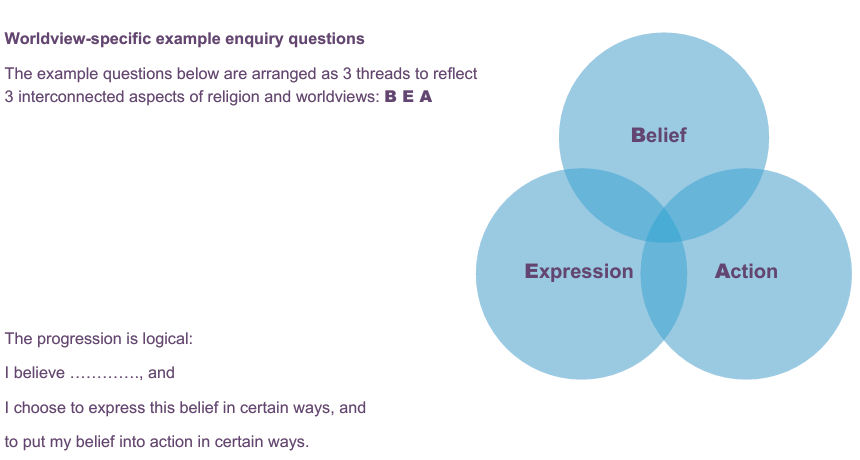
What you will almost never see in a Religion and Worldviews syllabus is material that helps teachers or students to distinguish between religions and worldviews and understand them as distinct yet interdependent phenomena. When the idea of a distinction is proposed, we are told that this would be non-inclusive. As the BCP syllabus puts it “to alleviate the risk of implied differentiation or preference.”
In short, to avoid marginalising worldviews that are not religions, the paradigm instead marginalises religions that are not worldviews.
Is it really true that syllabi often omit mention of the word Israel?
Many current syllabi do fail completely to mention the word Israel – a core concept in Judaism. As many syllabi lie behind paywalls with only shortened forms publicly available, a complete analysis avoiding false negatives is impossible. However, at least a dozen long and detailed syllabi can be confirmed to have done this (confirmed negatives). This is not a new problem and in fact newer RE Today syllabi are better on this front than older ones. Many others mention Israel only as the place where Jesus was born. Most others (including those from RE Today) mention Israel only as a place.
However almost all syllabi fail to explain the concept of Am Yisra’el (the People Israel) or the Children of Israel, and do not even mention Jacob (aka Israel), the biblical father of the Jewish people who gained the name Israel after he wrestled with an angel. (Israel = God-wrestler) They therefore fail to connect the concept of Israel with the fact that Abraham argued with God, and with the Jewish tradition of engaging in arguments for the sake of Heaven — we are a nation of God-wrestlers.
Thus, the term “Israelite” also remains confusing as is the word “Israel” when the phrase “Hear Oh Israel” in the Shema is taught. The origin of the word Judaism also remains unexplained, as this would link to the biblical person Judah, son of Jacob / Israel (whose twelve sons then became fathers of the twelve tribes of Israel aka the Israelites, of which the dominant tribe was Judah — thus the place called Judea by the Romans and the people currently known a Jews). This is all very basic knowledge that is often neglected.
Note: Abraham’s story is the beginning of the Jewish origin story, but he is the father of multiple nations in the Bible: Yishma’el / Arabia, Edom, and also Israel / Judah. Lessons about Abraham are best framed as foundational to learning about the Abrahamic religions, so that students understand how his story is understood differently in different traditions. For example, that the Ibrahim of the Quran has a very different nature (submission) from the Abraham of the Torah (who argues with God), and that the Christian reading of this Abraham is also distinct from the Jewish one.
The concept of an “organised worldview” includes all of the aspects of Judaism that you say are important. What am I missing?
Short answer: “Organised worldviews” as so broadly defined are not in fact worldviews at all. As a result, lessons that focus on the analysis of worldviews themselves will actually neglect “organised worldviews” if we mean by this term to include ethnoreligions such as Judaism. Teachers are more likely to use the plain meaning of the word worldview, which is incompatible with “organised worldviews” as more broadly defined.
Disentangling confusing terminology (some sources):
The various publications from the RE Council regarding worldviews contain several, possibly incompatible definitions including those of: worldview, personal worldview, institutional worldview, and organised worldview.
The 2018 CORE Report. defines worldview and institutional worldview as follows:
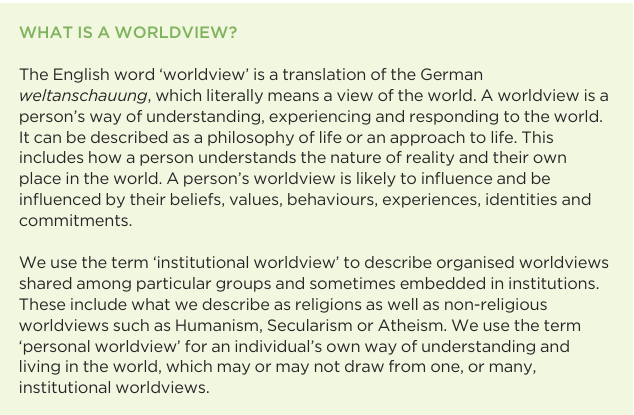
By this framing, religions are a subcategory of things called institutional worldviews, which are belief systems embedded in institutions. Religions and worldviews are identical to “religious and nonreligious worldviews”. Clearly this reductive framework excludes Judaism, which is why it was rejected by the Board of Deputies.
The 2023 National Statement of Entitlement avoids the problem by failing to define worldview, worldviews or any variant.
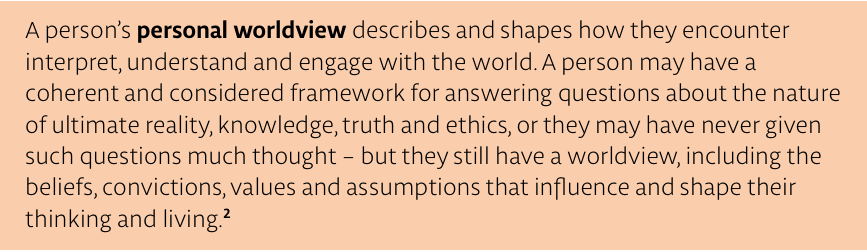
The 2024 REC Handbook distinguishes between personal worldviews and organised worldviews:
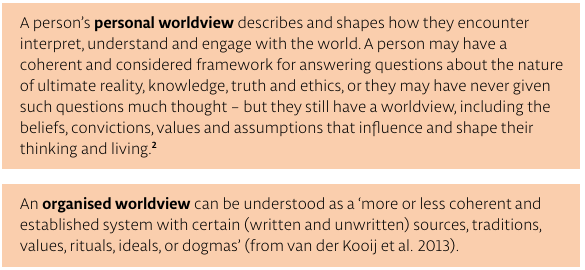
This appears to allow for organised worldviews that includes elements outside of a shared set of beliefs. However, any ambiguity is clarified by a further definition of organised worldviews in the same document:
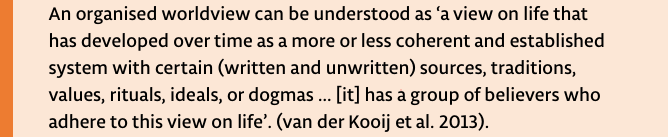
This document fails to define the term “worldview” itself but lists it as a “contested term” along with religion, religions and worldviews.
Does “organised worldview” as defined in the 2024 REC Handbook includes religions that are in their essence not institutionalised belief systems?
Arguably the answer is no, since even the Handbook includes the idea that an “organised worldview” is a “view on life”.
If yes, then “organised worldviews” are not worldviews at all — in which case the framework is dangerously incoherent. Teachers who understand words by their plain meaning will still frame religions as belief systems, as will be natural for those from a Christian cultural background. (The failure to define worldview does not solve the problem, as this word is well understood even if we avoid defining it. It means a view of the world – belief.)
Finally, if “organised worldviews” are indeed not worldviews, then it is difficult to explain the meaning of phrases such as “personal and organised worldviews”. If the word “worldviews” is being modified by the word “organised”, and then also is modified by “personal” in the term “personal worldview” in the very same breath, then we all know that this “worldview” is really a type of view.
Thus, Worldviews entrenches one of the primary errors for which the World Religions Paradigm was rightly criticised: the treatment of religions as belief systems.
Identity is a core aspect of a personal worldview.
Doesn’t that include Jewish identity?
A personal worldview does include identity as part of how an individual understands and response to the world, but this is subjective, individual identity, framed as part of a person’s belief system. However, Jewish identity is more than that, as it is objective and also communal.
Halachic status as a Jew exists independent of personal belief, observance or self-identification. All forms of Judaism (including progressive movements) maintain that one cannot become Jewish purely by self-identification – conversion involves formal acceptance and the answer can sometimes be no. The fact that different communal organisations may have different rules by which to assess claims to Jewish identity does not mean that Jewish identity is purely subjective.
Judaism is an ethnoreligion, and Jewish status is an inherited, inescapable reality. Thus, the experience of some people who discover they are Jewish when this information was withheld from them by parents (often due to the fear of antisemitism). Thus, also the experience of some Jews who attempt and fail to shed their Jewish status.
It is also very important to remember that neither the essential / objective nature of Jewish identity nor the right of Jewish communities to gatekeep Jewish status relies for its legitimacy on oppression faced by Jews either today or historically.
I thought Religion and Worldviews actually prioritised the diversity of lived experience. What exactly are you saying is missing?
The Worldviews framework does emphasise lived experience and diversity within traditions, which is valuable. What it misses is a balanced and coherent representation of Judaism’s lived reality as an ethnoreligion, such as the centrality of peoplehood. The focus on the worldview of the individual means that lived experience is presented far too much as the experience of an individual, rather than as a shared experience of a family or community.
The lived experience lens also focuses on diversity in the sense of how the “lived worldview” of every Jew is different, at the expense of showing what Jews have in common so that students gain a coherent understanding of Judaism in the very limited time allotted to teaching it. We are told that RE must be decolonised and avoid narratives. We just look at a range of lived experience, thus learning about religion intuitively. As Paul Smalley explains, “RE therefore becomes a series of dialogic encounters with various sweet and savoury treats”.
But in reality, someone is choosing which lived experience to amplify and which to ignore. These choices are typically driven by the priorities of non-Jewish editors crafting content to fit their own pedagogical goals: Judaism learning not for its own sake (not so that students understand Judaism better – substantive knowledge), but to help students to learn “how worldviews work” and about the importance of diversity as a general concept (disciplinary knowledge).
An example of this is the NATRE resource “Investigating Jewish Worldviews“.
- This has a two page spread on the Messiah that does not once mention the ingathering of exiles to the Land of Israel, or the connection between the House of David and the dream of Jewish sovereignty.
- This has six pages on Jewish attitudes towards animals, including vegetarianism, but not mentioning once Jewish ethical rules regarding how animals are slaughtered and eaten (shechita).
- This also ironically includes two pictures of synagogues, both of which are orthodox, thus not explaining perhaps the most important distinction that diversity would require regarding synagogues in the UK: that some have men and women separated and others have mixed seating.
In conclusion, resources depicting the diversity of lived experience do not necessary teach authentically about what matters to most Jews or help non-Jewish students understand what Jews have in common, and neither do they necessarily show the aspects of diversity that are most important to remember, because the lived experience presented to students itself is typically chosen to suit a narrative that serves non-Jewish priorities.
Aren’t RE resources on Judaism already high quality and written by subject experts?
Many resources are created with good intentions, but without authentic co-authorship by Jewish RE subject experts, they often reflect non-Jewish misconceptions about Judaism or fail to prioritise those aspects of Judaism that are most important.
Examples:
- NATRE’s Investigating Jewish Worldviews resource contains six pages about Jewish attitudes towards animals and vegetarianism but fails to mention even once Jewish ethical rules regarding slaughtering animals for food (shechita).
- One recent syllabus proposal authored by experts stated that Reform Jews do not pray in Hebrew!
- Many syllabi fail completely to mention the word Israel – a core concept in Judaism. Many others mention Israel only as the place where Jesus was born. Most others mention Israel only as a place but fail to explain the concept of Am Yisra’el (the People Israel) or the Children of Israel, and do not even mention Jacob (aka Israel), the biblical father of the Jewish people (Israel). Thus, the term “Israelite” also remains confusing and unexplained as is the phrase “Hear Oh Israel” in the Shema, which is taught.
Note: Abraham is the father of several nations in the Bible: Yishma’el / Arabia, Edom, and also Israel / Judah. - This omission of Israel as more than a place is particularly problematic because understanding the relationship between Judaism and Christianity is impossible without the concept of Israel. The early Church conceived itself as being Israel (thus the Christian idea of the new covenant / New Testament). This neglect within Judaism teaching also means that if the concept of Israel is taught in Christianity (as it should be), this will mislead children who do not understand its Jewish origins.
- BBC Bitesize materials to support the Judaism GCSE paper. These likely reflect the distorted priorities of the GCSE course rather than those of the BBC.
- States that orthodox Jews don’t have bat mitzvah. Also misses the link between bar/bat mitzvah and the idea of covenant, teaching that the bar/bat mitzvah is a ceremony (wrong) as opposed to the child (correct).
- Fully half of the theology material concerns life after death. This is not an important topic in Judaism, which is this-world focused. This is a very odd choice of priorities when there is so little space in the curriculum for important content. (The other half concerns Messiah and God.)
- Oddly, the discussion of God lists various aspects of God from Jewish philosophy, but not the most important observation that distinguishes a Jewish belief in God – that of the relationship between God and Israel akin to a marriage. That for Jews, faith in God is about being faithful — that Judaism understands the second statement of the decalogue as an injunction never to pray to God through any intermediary – whether an object or a person. This what students need to understand so that they can grasp how different Jewish monotheism is from that contained in Christianity or Hinduism.
- Finally, the pages on theology and moral principles omit the most important moral concept in Judaism — that of human beings created in the image of God. This underpins all of Jewish ethics, including the concept of pikuach nefesh and the rule that burial takes place quickly after death.
- The issue here is one of priorities – a failure to include essential concepts because space has been used for material that is far less relevant. But the priorities here were not chosen by Jews.
I thought the Worldviews framework was created precisely to decolonise RE – to address the problem of a Christo-centric framework imposed on religions. What did I miss?
The Worldviews framework indeed is founded on a decolonisation critique of the “world religions paradigm”, which imposed a Protestant-derived model of religion onto diverse traditions. The move away from rigid belief-centred RE was a welcome move that was already bearing fruit in the Believing-Behaving-Belonging framework that was common in the RE of the 2010s well before Worldviews became the standard.
However, framing Judaism as a “religious worldview” actually re-imposes the very belief-focused model that Worldviews proponents claimed to decolonise: prioritising propositional beliefs and personal interpretation over Judaism’s relational, covenantal, practice-based, ethno-religious reality.
Yes, it is true that many syllabi that implemented Believing-Behaving-Belonging focused excessively on belief, given the cultural bias of those writing syllabi. Progress was visible but frustratingly slow.
The solution should have been to focus on expanding coverage of Behaving and Belonging, rather than compacting all aspects of religion other than propositional belief into “Human and Social Sciences” (including curated examples of “lived experience” in place of coherent understanding of these aspects of religion). Belief was then expanded into the separate spheres of Philosophy and Theology, reinforcing the existing bias.
This backwards move discriminates against ethnoreligions like Judaism, which bind people together as a religion primarily through peoplehood and action, not primarily through shared “views.”
Aren’t you just promoting a particular Jewish worldview at the expense of others?
No.
AJREP includes professionals across the full spectrum of Jewish backgrounds and seeks authentic representation of Judaism as Jews experience and teach it: A lived ethnoreligion with diversity in observance/belief but unified by peoplehood, history, practice, and covenant.
Those of us who engage seriously in RE Judaism — the challenging activity of making Judaism comprehensible to those who are not Jewish — we find that we agree on most of the basics of what is important to teach about Judaism. Because when it comes to non-Jewish understanding of Judaism and the real danger that we as a community are misunderstood, the disagreements between different movements quickly appear trivial.
Whatever our Jewish background, we seek to promote respect of all communities within Judaism, rather than promoting one particular worldview or attempting to score points off other Jews.
We agree that the focus of Judaism RE should be on what unites Jews, with diversity taught in order to give breadth and avoid stereotypes, but with the focus on what Jews have in common.
I thought that people engaged in religious practices because they believe their religion is true. Why is this incorrect?
For many religions, propositional truth (beliefs about reality) drives practice. In Judaism, the relationship is often reversed: practice (mitzvot) often precedes or shapes belief. The principle of na’aseh venishmah (“we will do and we will hear”) emphasises action and covenantal commitment first, with understanding emerging through the lived relationship between Israel and God and Torah.
Thus, the Jewish philosopher Crescas argued that we fulfil the commandment to believe in God by performing mitzvot.
Framing Judaism as primarily containing propositional beliefs (a “worldview” one holds true) misrepresents this relational dynamic and sidelines Judaism’s emphasis on holiness through practice.
When you say belief in Judaism is primarily relational rather than propositional, what do you mean?
Propositional belief = holding statements as true (e.g., “God is omniscient.” “There is an afterlife.”).
Relational belief = living in covenantal relationship with God through action, community, and history (e.g., observing mitzvot as a response to Sinai covenant, directing prayer toward Jerusalem, celebrating festivals tied to peoplehood).
A core principle in Judaism is that of Faith in Practice (na’aseh venishmah).
The core of the Jewish belief regarding God is not an assertion of a fact – a statement of truth for which one will seek agreement or disagreement. It is that we (Jews) are in a committed loving relationship with God and we have a duty to be faithful and not to let God down by worshiping things that are false, or by misusing God’s name to promote some private interest, or by praying to God through anyone or anything. This faithfulness to God is very different from listing truth claims about God.
Surely, since so many children don’t identify with a religion, the way to achieve social cohesion is for children to examine big questions and reach answers together. Why isn’t that enough?
Big Questions and shared inquiry are valuable for critical thinking, but as we have seen in real world lesson plans, these activities risk descending into arguments over which beliefs are or are not justified.
When discussion is around a public policy question for which societal consensus is needed (such as abortion or assisted suicide legislation), debate can be constructive, but with regard to religious beliefs (which by construction are not capable of scientific or logical proof), such activity can place pupils from minority communities under pressure to conform with their peers. This risk is all the more serious in lessons led by non-specialist teachers.
A focus on developing the personal worldview of the child also detracts from a key lesson of RE, which is learning to think beyond yourself and beyond the question of whether beliefs or practices are correct or reasonable. The intellectual challenge is precisely to engage with what it is like to be another, without judgment. When it stops being all about me, real learning begins.
Some people think that avoiding such argumentation is dangerous because it means avoiding intellectual engagement to challenge wrong beliefs. This misses the fact that religious beliefs are rarely adopted or shed simply in response to logical arguments. Moreover, if you are concerned about expanding the experience of children from rigidly conservative backgrounds, parents of such children must be able to trust teachers not to interfere with the religious upbringing of their children. Then such children will feel safe exploring and learning about those who are different, which is what really matters if we care about social cohesion.
In short, RE teachers must resist the temptation to correct doctrinal errors. Aside from the safeguarding or Equality Act violation, this invariably backfires.
As the late Chief Rabbi Lord Jonathan Sacks taught, the key to building respect for difference is not debate, but conversation.
“In a debate one side wins, the other Ioses, but both are the same as they were before. In a conversation neither side Ioses and both are changed, because they now know what reality looks like from a different perspective.”
Why is teaching Judaism important given that such a small fraction of the British public are Jewish?
Children’s futures are not limited to their birthplaces; they need understanding for life in diverse Britain. Antisemitism prevention requires understanding authentic Judaism, not stereotypes or Christian-filtered versions. Social cohesion depends on mutual understanding, which requires substantive knowledge of all major UK faith communities
Moreover, because Christianity and Islam contain concepts drawn from Judaism, when only the former religions are taught, children end up learning Jewish concepts through a Christian or Muslim lens. To avoid a distorted understanding of Jewish concepts, they must also be taught as part of Judaism and the links with other traditions must be acknowledged.
The pattern of teaching Judaism in KS1 then only encountering Jews again through the Holocaust in KS3 also creates deeply problematic associations and prevents understanding Judaism as a living tradition.
Similar arguments apply to other minority faiths, which must also be given due space as part of a spiral of learning. A rebalancing of RE is needed that emphasises breadth over depth.
Doesn’t teaching children about difference just encourage division?
Teaching accurate difference promotes understanding, empathy, and cohesion. The key is to build substantive knowledge about lived traditions, rather than engaging in evaluative debates. By contrast, misrepresentation or erasure (e.g., downplaying Jewish peoplehood) fosters ignorance and division. Well-taught RE about Judaism as a living ethnoreligion helps pupils recognize shared humanity while respecting distinct identities, reducing stereotypes and building mutual respect.
As the late Chief Rabbi Lord Jonathan Sacks taught,
“The only adequate response to the fear and hatred of difference is to honour the dignity of difference. That is the Jewish message to the world.”
If religions are not framed as a type of worldview, doesn’t that marginalise nonreligious worldviews that are not religions?
No. Non-religious perspectives such as Humanism and Secularism can be taught distinctly as organised systems or personal orientations without forcing religions into the same “worldview” category.
Acknowledging that religions and worldviews are distinct phenomena does not marginalise or belittle non-religious worldviews any more than it belittles Judaism to say it is not a type of Christianity. On the contrary, what marginalises or belittles a tradition is to misrepresent it or force a framework on it that does not fit (for example portraying Sikhi as a variant of Hinduism).
Those who are not religious must accept that religions (especially ethnoreligions) have binding, communal, historical realities that are not captured by the “worldview” lens in the same way that those who are religious must accept that non-religious people do not experience their approach to life as fitting the concept of a religion.
If religious and nonreligious people can both do this, then there can be true inclusion and mutual respect.
Worldviews is meant to challenge the idea that religions are discrete and self-contained. What links between religions are being neglected?
In practice, Worldviews syllabi and lessons typically make connections between religions only when exploring answers to Big Questions or engaging in philosophy.
Because they tend to neglect substantive knowledge that is not about beliefs and because analysis of aspects of religion outside of belief tend to focus on individual lived experience, these curricula typically neglect historical, practical, linguistic and experiential links between traditions as cohesive wholes.
Thus, students rarely learn how Christian or Muslim concepts or practices are rooted in Jewish concepts or practices, or links between other religious traditions. Examples:
- Churches and synagogues are both models of the Temple in Jerusalem, but in different ways.
- Communion and the Shabbat dinner both include bread and wine because, again, they are both rooted in ancient Jewish ritual.
- The “two great commandments” taught by Jesus are the same as those taught by other rabbis of his time such as Hillel (and come from the Torah – they were not authored by Jesus).
- The Muslim teaching that “he who saves one life saves the world entire” originates in the (Jewish) Talmud.
- The Abraham of the Torah and the Ibrahim of the Quran are both the same person and also very different people. (Abraham is famous for arguing with God; Ibrahim is praised for submitting to God.)
- Children will commonly be taught that original sin is an essential part of the Adam and Eve story in spite of Jewish interpretations of these texts explicitly rejecting the concept. (It should be made clear when an interpretation of a shared text is specifically Christian and not universal.)
- Lessons on the Messiah in Judaism and Christianity almost always fail to explain how the concepts in the two religions are different, since two Hebrew / Jewish words (moshia / saviour and mashiach/annointed) were combined (as they sound the same when transliterated) in the Christian / Greek concept of “Christ.”
- Similarly, there are concepts in Hinduism and Sikhi (eg. maya, guru) that share names due to a shared linguistic heritage yet are quite distinct. This can lead to confusion when learning about Sikhi, and frustration on the part of Sikhs, who are a smaller minority.